


Energy engineering that transforms every
barrel

Oil remains a cornerstone of the global energy system, both for its direct contribution as a primary energy source and for its strategic role in industrial and economic stability. Far from being a static industry, the oil sector has evolved toward more efficient, integrated, and technologically advanced models, driven by digitalization, automation, and data-driven decision-making.
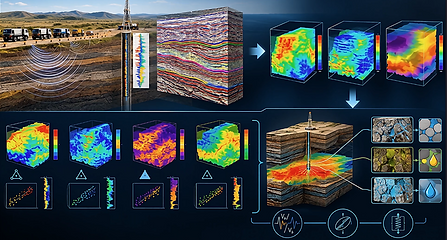
Currently, hydrocarbon exploration and production rely on high-resolution geological and reservoir models, numerical simulation, and integrated data analysis. These tools allow for reduced uncertainty, optimized drilling, and maximized recovery, especially in mature and complex reservoirs.
To meet this anticipated demand, the major OPEC members (led by Saudi Arabia) agreed to restart more wells in October, adding an additional 2.2 million barrels per day that had been idled. Even so, the announcement barely depressed prices: a barrel of Brent crude is currently hovering around US$67. OPEC sees this as a validation of its strategy, but admits that in recent years its internal forecasts have been overly optimistic and do not always coincide with those of other analysts.
In its internal projections, OPEC estimates that global oil demand will grow by 1.3 million barrels per day this year, a pace nearly 40% faster than estimates from major financial firms like Goldman Sachs. This view contrasts with that of other entities: for example, the International Energy Agency (IEA) expects a record surplus of more than 3 million barrels per day by 2026, due to slower demand in China and booming production in the United States and other regions In short, OPEC speaks of a tight market, while others predict an oversupply.
These conflicting forecasts reflect global uncertainty. If the OPEC deficit is confirmed, we could see a spike in oil prices, which would make gasoline, diesel, and energy in general more expensive for the global economy. But the U.S. government projects the opposite: the Energy Information Administration (EIA) estimates that global reserves will grow by more than 2 million barrels per day in the near future . Under this scenario, it estimates that a barrel of Brent crude oil would fall to around US$51 by 2026. Ultimately, the oil market will be closely monitoring economic factors (global growth, Chinese demand, etc.) and political factors (OPEC+ decisions, US shale production, etc.). What OPEC+ does in the coming months will be key, as it will directly influence the price of crude oil and its effects on inflation and the global economy.
Did you know?
Producing oil also requires large amounts of energy
In the oil business, energy isn't just sold: it's also consumed intensively to produce it. Every barrel of crude oil that reaches the market is the result of a chain of technical processes that demand energy from the very first day of operation.
During drilling, energy is used to power high-torque equipment, fluid circulation systems, and pressure control. Once the well is in production, energy consumption continues through artificial lift systems, such as mechanical pumping, electric submersible pumping, or gas lift, designed to overcome the natural conditions of the reservoir.

From a technical and economic standpoint, this energy consumption directly impacts the operating cost per barrel. Therefore, optimizing equipment efficiency, selecting appropriate production methods, and improving integration between subsurface and surface operations can generate significant savings, as well as reduce emissions and extend the lifespan of assets.
From Rock to Barrel


De la Roca al Barril es una iniciativa de divulgación técnica orientada a difundir el conocimiento especializado de la industria de los hidrocarburos mediante una serie de videos educativos. Cada entrega aborda conceptos, tecnologías y procesos fundamentales de la cadena de valor del petróleo, con un enfoque riguroso, didáctico y accesible para profesionales, estudiantes y todas las personas interesadas en el sector energético.


Production Decline
Geomechanics

Seismic

Water Production

Horizontal Drilling

Clays

Refinement

Stratigraphy

Petrophysics

Drill Bits

Promotional Video II

Geochemistry

Geochemistry

The Geoid

Promotional Video

Artificial Lift

Sedimentology

Seismic Acquisition

Asphaltenes
Asphaltenes
Technical Talks
APPLICATION OF GELS FOR WATER CONTROL IN OIL WELLS
MSc. Oscar Rausseo

MARKETING IN THE INDUSTRY OF
HYDROCARBONS
Eng. José Hugo Contín
UNDERSTANDING HOW IT WORKS
FROM THE TRIPLEX PUMP
Eng. Jaime Ciscar
IMPACT OF ENHANCED RECOVERY IN CRUDE OIL FIELDS
Eng. Evelyn Quintero
CYBER RISKS IN THE OIL
INDUSTRY
PhD. Ramón Perdómo
MODERN APPLICATIONS OF SURVEYING AND GEODESY IN BASIC INDUSTRIES
Dr. Melvin Hoyer
HOW DO I DESIGN AND CONSTRUCT AN OIL WELL?
MSc. Gustavo Suárez
IS DILUTION OF EXTRA-HEAVY CRUDE OIL A GOOD OPTION FOR TRANSPORTING IT?
MSc. José Gregorio Tovar
NANO PARTICLES FOR TRANSPORT OF
HEAVY CRUDE PRODUCTS
MSc. José Gregorio Tovar
USE AND ABUSE OF MULTICOMPONENT SEISMIC IN RESERVOIR CHARACTERIZATION
MSc. Javier Antonio Pérez Arredondo

Short Technical Notes
SPACING OR ARRANGEMENT BETWEEN OIL WELLS
FROM GEOLOGY
MSc. Miguel Marquina
GEOLOGICAL FACTORS THAT AFFECT THE SUCCESS OF THE
WELLS DRILLED ON ACTIVE MARGINS
MSc. Miguel Marquina
HAVE WE REACHED “PEAK OIL”?
WHAT TO DO WITH OUR MATURE DEPOSITS?
MSc. Miguel Marquina
DEFINITIONS FOR HARNESSING SUBSURFACE HYDROCARBON RESOURCES - GEOLOGICAL MODEL
MSc. José Gregorio Tovar
PROJECTS TO CONSTRUCT, COMPLETE OR REPAIR WELLS
THAT PRODUCE HYDROCARBONS - PLANNING
TYPES OF HOLES IN A PRODUCING WELL
HYDROCARBONS
MSc. José Gregorio Tovar
MSc. José Gregorio Tovar
Definitions for harnessing underground hydrocarbon resources. Stress distribution in the subsurface and equilibrium with drilling fluid.
MSc. José Gregorio Tovar